The children of Holocaust, the last generation of the witnesses of Shoah and the Vilna Gaon Museum of Jewish History consider their ultimate duty to reveal to the general public the stories of the Jewish survivors and to perpetuate the names of the Lithuanians who rescued Jews during the war.
The stories about the tragedy that had befallen Lithuanian Jews, the loss of loved ones and miraculous salvation are told by former Jewish children – the most vulnerable group of the people persecuted and massacred during the war. These rescued children however are a small group of the Lithuanian Jewish children living when the war started. More than nine out of ten Jews who had lived in Lithuania before the war fell victim to the systematic mass killings. However, even during the days of horrible atrocities, abominable anti-Semitism, incited hatred and menace, there were people in Lithuania whose determination, sacrifice and courage saved many lives.
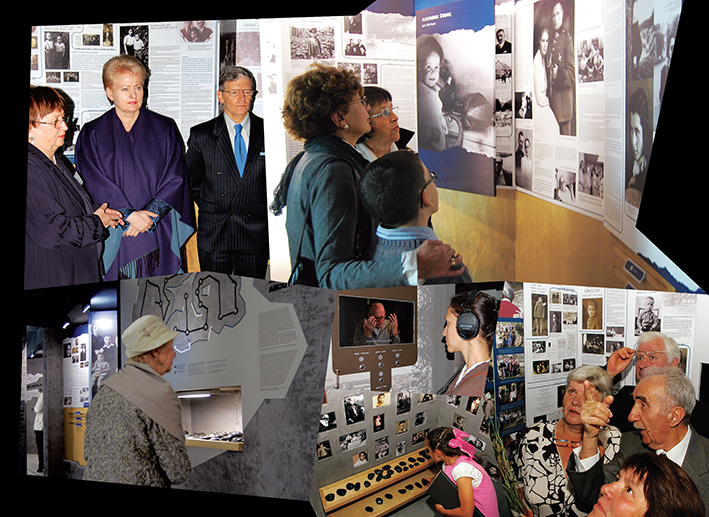
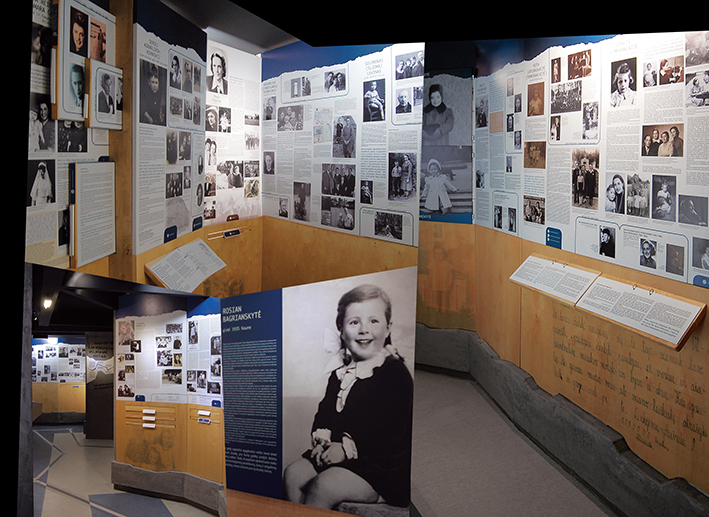
This exhibition also serves as an education centre – the authentic testimonies, family pictures and video interviews of Holocaust witnesses reveal the catastrophic period for all the Jews – the Holocaust that once took place in the land of Lithuania.
The visitors of the museum following the broken paths of the exhibition will experience at least a small part of what the hiding and persecuted people had to endure – stress and fear that accompanied them and their rescuers throughout the entire war.
With the end of the German occupation in Lithuania, some of Lithuanian Jewish children were liberated and saved from death. The years of fear, suffering and painful losses were over. Many children lost their parents, brothers and sisters, but became free.
Each story of a rescued child is unique, but the complexity of the situation led to some common patterns in all of those stories. Generally, efforts of many people were required to save a single Jewish child. First, reliable people had to be found who would agree to risk their lives and the lives or, at least, the wellbeing of their loved ones in order to save a Jewish child.
Whereas babies and small children sometimes would not even realize that they were in hiding, but for the elder children parting with the parents – although living in the ghetto – was often very traumatic. They had to forget their real names and get used to new ones, they had to learn to adapt to a new environment, live in hiding, sometimes even without getting a chance to go outside.
People who are remembered by the survivors all their lives – the Righteous – decided to save the Jews out of their good heart and compassion, because they just couldn’t watch the killing of innocent people – including women, the elderly and children.
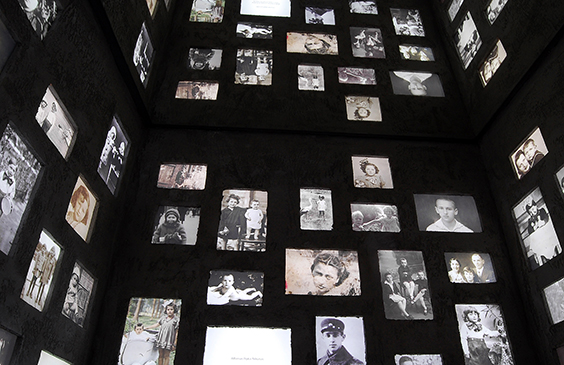
The unique accent of the exhibition is the interactive memorial. Children, still smiling in our hearts, are looking at us from authentic pre-war pictures.The survivors themselves tell about their experiences when all human values were trampled.
Let us listen to the stories of the rescued children of Holocaust – this can not be forgotten...
Nazi ideology sentenced every Jewish child to death
When World War II began, Jewish children, confronted with an invincible, unstoppable and devastating power, became the most vulnerable social group. Nazi ideology sentenced every Jewish child to death. Before the war, 1.6 million Jewish children lived in the countries occupied by Wehrmacht and Germany’s allies. More than one million of these children became the victims of the Nazi planned genocide.
Thousands of Jewish children were killed together with their parents during the executions that took place in the territory of Lithuania in the summer and autumn of 1941. The remaining children were imprisoned together with the adults in the ghettos established in the cities of Vilnius, Kaunas, Šiauliai and Švenčionys. Only a few were meant to survive the never-ending actions of extermination.
In the ghettos, children as well as the elderly, who could not do forced labour and therefore became ‘useless’ to the Wehrmacht , were condemned to annihilation.
The history of the Kaunas Ghetto was marked by the Great Action, during which 2,007 Jewish men, 2,920 women and 4,273 children were shot dead in the 9th Fort on 28-29 October 1941.
The first Children’s Action was carried out in the Šiauliai Ghetto on 5 November 1943. That day, 570 children and 260 elderly people were taken in boxcars to Auschwitz and killed. The extermination of children and invalid Jews was supervised by the SS-Hauptsturmführer Förster from the Einsatzkommando 3A.
When the liquidation of the Vilnius Ghetto started, about 5,000 women and children were taken to Majdanek and Auschwitz concentration camps and killed, while several hundred old and sick people were shot in Paneriai.
27-28 March 1944, the Children’s Action was carried out in the Kaunas Ghetto. About 1,700 people were taken away including 900-1,000 children. The action was supervised by the head of the Lithuanian concentration camps SS-Obersturmbannführer Wilhelm Göcke.
27 March 1944, Children’s Actions also took place in “Kailis” and HKP 562 Jewish labour camps in Vilnius. 250 children and old people were transported from the “Kailis” camp in an unknown direction. Only a few children from the HKP labour camp managed to hide and avoid being taken away.
In July 1944, a few days before the liberation, during the operations of liquidation of Šiauliai and Kaunas ghettos, the last inhabitants of the ghettos – adults and children – were killed or taken to concentration camps.
When the front line passed, pictures of former inhabitants of the Kaunas ghetto and their loved ones could be found among the ruins of the burnt Kaunas Ghetto, charred bodies and personal belongings.
Children are looking at us from these pictures. Children, whose names and exact places of death were recorded. And children whose names and fates remain unknown to us...
Organisers of the exhibition A Lithuanian Jewish child tells about Shoah
Link to exhibition page: http://rescuedchild.lt/content.php?id=11